

Current Affairs Conference on “Successful Experiences in Mobilizing Tax Resources: What Lessons for African Countries with High Tax Potential?”
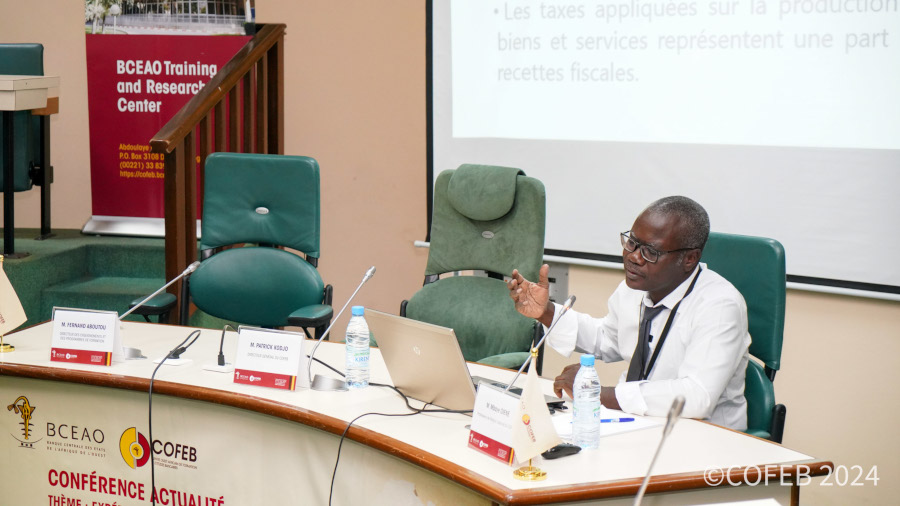
On Monday, July 15, 2024, at 3:30 p.m., the West African Center for Banking Studies and Training (COFEB) held a current affairs conference on “Successful Experiences in Mobilizing Tax Resources: What Lessons for African Countries with High Tax Potential?”.
The keynote speaker of the conference was Mbaye Diène, Professor of Economics at Cheikh Anta Diop University in Dakar and Affiliate Grade A professor with COFEB. The event took place in person at Auditorium A of the Center and was attended by students from COFEB’s 46th graduating class.
The conference was chaired and moderated by Patrick Kodjo, General Manager of COFEB.
In his introductory remarks, the General Manager emphasized the importance of the subject matter, which was a topic of ongoing concern for the monetary authorities of the West African Monetary Union (WAMU). He pointed out that the tax ratio in the region ranged between 15% and 16%, falling short of the Union’s standard of 20%. As such, he underscored the need for Member States to intensify their efforts and, where necessary, adjust their fiscal policies to meet the established benchmark. He concluded by encouraging the audience to pay close attention to Professor Diène’s presentation, in order to gain useful insights and arguments to support their countries’ efforts in addressing tax-related challenges.
Speaking after the General Manager of COFEB, Professor Diène explained that the subject of the conference had emerged from discussions with a colleague regarding the broader context of taxation, and that the insights from those discussions would be published in book form in the near future. He went on to say that tax revenue generated by African countries was comparatively lower than that of countries in other regions of the world. Citing data from the Organization for Economic Cooperation and Development (OECD), he noted that in 2019, the average tax burden in Africa was 16.6%, compared to 22.9% in Latin America and 33.8% in OECD countries. The main factors contributing to this phenomenon were believed to be their narrow tax bases owing to their non-diversified economies, as well as the scope of the informal sector.
It was therefore imperative for these countries to broaden their tax bases, which were already undermined by falling commodity prices and a decline in state aid and donor funding. However, to achieve that goal, they needed to identify appropriate strategies to increase tax revenue without destabilizing their economies. This required careful consideration, as broadening the tax base often comes at the cost of reduced investment and slower economic growth.
To address this dilemma, the speaker focused his presentation on three main points: trends in the tax burden and tax structures in Africa, measuring tax potential, and identifying strategies and public policies to meet the challenge of the tax effort.
Addressing the first point, Professor Diène defined the tax burden as an indicator of a country’s tax effort, calculated as the ratio of total tax receipts to gross domestic product (GDP). He explained that the tax structure referred to the breakdown of the various types of taxes contributing to total tax receipts.
The speaker highlighted the persistently low tax burden in Africa, noting that between 2018 and 2020, the tax burden increased by only 0.6 percentage point (22.2%, 22.5%, and 22.8%). He emphasized, however, that disparities existed between countries, with some exceeding the African average of 22.8%, while others, especially in sub-Saharan Africa, remained below the average ratio. A similar pattern can be found in tax structures, which vary considerably from one country to another. Analysis of the data revealed that it was still possible for those countries to achieve the optimal tax burden set by the IMF and WAMU at 15% and 20%, respectively. It should be noted that those thresholds were established using the stochastic frontier estimation method, assuming optimal conditions in terms of tax administration, policy implementation, and economic performance. Accordingly, countries with a low tax burden should move closer to the optimal tax burden.
To assess the tax potential of the African countries in the selected sample, the speaker also used the stochastic frontier approach (SFA) to determine the tax efficiency frontier and the tax gap. The tax efficiency frontier represents the set of countries that are most effective in mobilizing various types of tax revenue, while the tax gap indicates how far each country is from the optimal frontier.
The findings of the study allowed the sample countries to be divided into three categories based on their tax collection performance from 2000 to 2022 (low, medium, or high). Thus, the countries furthest from their tax efficiency frontier should be encouraged to explore strategies to narrow the gap, particularly by drawing on the experiences of countries that had successfully met the challenge, such as South Africa and Namibia.
Addressing the final point concerning the identification of strategies and public policies to meet the challenge of increasing tax effort, the speaker emphasized that this would inevitably require an improvement of the tax system. To support his arguments, he referred to successful experiences from various countries that had effectively tackled similar challenges.
Thus, to increase tax revenues, the following recommendations can be made according to Professor Diène: (i) adopting reforms aimed at reorienting tax policy goals and implementation methods, as demonstrated by Morocco and Senegal, (ii) a more equitable distribution of taxes based on each country’s fiscal potential, (iii) the introduction of new technologies into tax administration, as implemented in the United States, (iv) better evaluation of transfers within transnational companies, (v) taxation of profits repatriated by mining companies, (vi) increased excise duties following the Gambian example, (vii) reduced tax benefits for investors, (viii) more effective application of value-added tax (VAT), (ix) increased taxation of urban real estate, and (x) the renegotiation of certain mining contracts as initiated in Guinea. He also emphasized the need for governments to undertake bold reforms.
In conclusion, Professor Diène indicated that increasing tax revenues in African countries would necessarily be posited on better tax administration, tailored to each country’s specific tax potential, and upholding the principles of equity, justice, efficiency, and trust.
Following the presentation, discussions centered mainly on the measures implemented in Africa and specifically in WAEMU to boost tax revenues, whether it was appropriate to use the stochastic model, and the suitability of the current tax burden threshold within WAEMU. Professor Diène responded to each of those points of concern.
The General Manager of COFEB brought the session to a close by once again extending his gratitude to Professor Diène for his very insightful presentation and to the audience for the quality of the discussions.