

Training on: “Basel II-III prudential regulation”
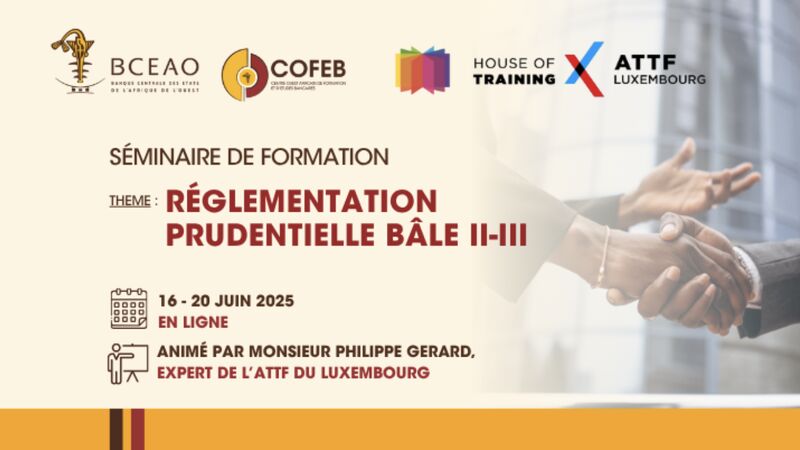
From June 16-20, 2025, COFEB organized an online training session on: “Basel II-III prudential regulation” for WAEMU credit institution executives. This capacity-building activity was organized in connection with the partnership between COFEB and the House of Training - Financial Technology Transfer Agency (ATTF) of Luxembourg.
The training was part of ongoing efforts to raise awareness of the Basel II-III prudential framework applicable to credit institutions and financial companies in the West African Monetary Union (WAMU). Its aim was to explain the prudential framework, gather feedback from stakeholders, and support the banking and financial ecosystem in implementing regulations in line with BCEAO recommendations.
The session was attended by some fifty participants, mainly comprising executives in charge of commitments, risk control, and compliance at credit institutions in the Union, as well as Central Bank officials.
The opening ceremony took place on June 16, 2025, and was chaired by Mahaman Tahir Hamani, General Manager of COFEB. In his opening remarks, Mr. Hamani reiterated that the Basel II-III prudential framework, transposed into WAMU standards by the BCEAO in 2018, was designed to strengthen risk management and resilience in the banking sector by requiring credit institutions to comply strictly with capital adequacy and transparency standards. In line with this approach, a seminar was held to promote a better understanding of the system through discussions between experts from the House of Training-ATTF, the BCEAO, and participants, while addressing concerns raised by regulated institutions. It also aimed to foster active participation and experience sharing among stakeholders to ensure greater financial stability within the Union.
The proceedings were facilitated by Philippe Gérard, an expert from the House of Training-ATTF with over 30 years of experience in the field of banking risk management. A former senior executive and director in the banking sector, Mr. Gérard drew on his professional experience in Africa, Europe, and Asia to provide practical insight into Basel II-III principles. He was assisted by specialists from the BCEAO's Financial Stability Directorate.
The training was organized around four main modules. The first focused on the fundamentals of the Basel Accords, highlighting major changes in the prudential framework between Basel I and Basel III, as well as the particularities of their transposition in the West African Monetary Union (WAMU). Module two covered the quantitative requirements of Pillar 1, particularly with regard to calculation of capital requirements in terms of credit, market, and operational risks. The third module dealt with Pillar 2 requirements pertaining to the prudential supervision process, through the prism of risk profile, internal capital adequacy assessment (ICAAP), and governance. Finally, module four addressed Pillar 3 provisions relating to market discipline, with a focus on prudential information transparency and disclosure requirements.
Each module was interspersed with interactive discussions, giving participants the opportunity to share their experiences in implementing the prudential framework.
At the close of the training program, the participants praised the quality of the content and the clarity of the presentations. They also expressed their satisfaction with the way their concerns were addressed and with the quality of the facilitators’ responses regarding the practical implementation of the Basel II-III prudential framework.