

Publication of the 37th edition of the BCEAO’s economic and monetary journal (REM)
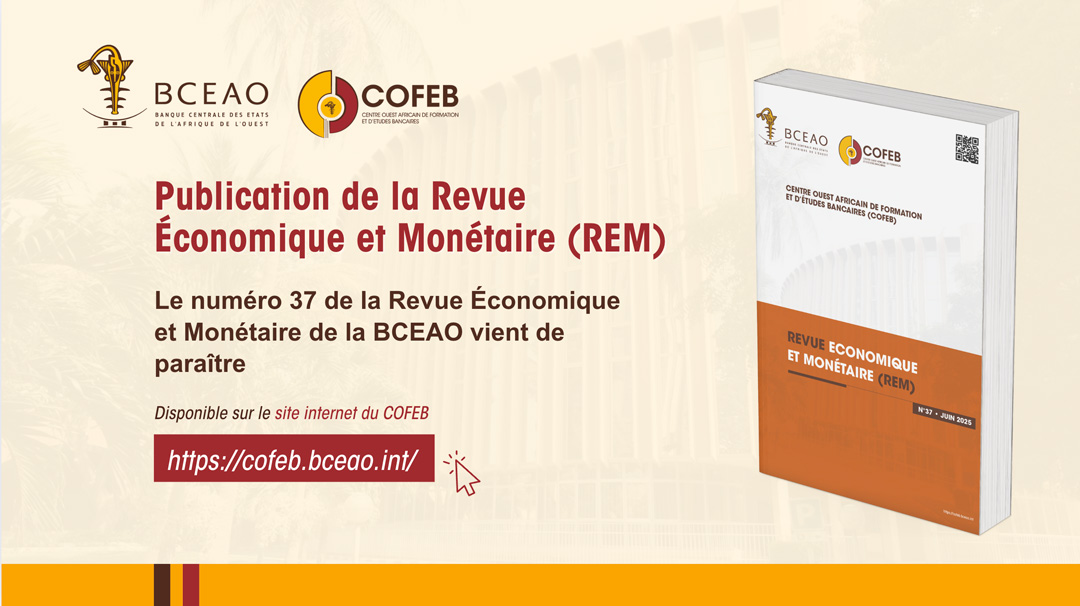
The thirty-seventh issue of the BCEAO’s economic and monetary journal (Revue Economique et Monétaire - REM) has been published on the COFEB website. This issue of the journal comprises two articles: (i) The impact of institutional quality on intra-regional export diversification in sub-Saharan Africa and (ii) Determinants of youth self-employment in Burkina Faso: empirical evidence in urban areas.
The first of the two articles assessed the impact of institutional quality on intra-regional export diversification in Africa in a continental context marked by the implementation of the African Continental Free Trade Area (AfCFTA) Agreement, where the issue of export diversification remains a major challenge. In their study, the authors focused on the countries of four regional economic communities (RECs) over the 2002-2022 period, namely the Economic Community of West African States (ECOWAS), the Economic Community of Central African States (ECCAS), the Common Market for Eastern and Southern Africa (COMESA), and the Southern African Development Community (SADC). Based on an econometric analysis of the relationship between export concentration indices and World Bank governance indicators, the authors showed that improving institutional quality was beneficial to export diversification in the RECs and therefore recommended improving institutional quality to speed export diversification in the regional economic communities.
The second article dealt with the issue of youth employment, a major challenge for policymakers within the West African Economic and Monetary Union (WAEMU). Its aim was to identify the determinants of self- employment among young graduates in urban areas of Burkina Faso, notably in Ouagadougou and Bobo- Dioulasso. The study was based on a survey of 559 students in the final stages of their bachelor's or master's degrees, 22% of whom were self-employed. Using an econometric model to assess the factors determining whether the respondents entered into self-employment, the study showed that greater government involvement in programs promoting entrepreneurship and self-employment increased the likelihood that students would choose that path. Other factors contributing to the choice of self-employment included cash flow constraints, academic specialization, market experience, and family structure. Among their recommendations, the authors emphasized the need to facilitate access to financing for youth entrepreneurship projects and strengthen institutions that promote entrepreneurship and help young people enter the workforce.
In conclusion, the thirty-seventh issue of the REM underscores the importance of institutional quality for export diversification in Sub-Saharan Africa's regional economic communities, while also highlighting the factors that influence young graduates’ decisions to enter into self-employment in urban areas in Burkina Faso.
To download the document, please click on the icon below.
Enjoy your reading !